In June 2026, automotive chipmaker indie Semiconductor launched its next-generation edge AI SoC, the iND881, purpose-built for automotive camera perception systems. It integrates an NPU, DSP, and quad-core ARM Cortex-A53 CPU, supports simultaneous multi-camera input, and features an HDR image signal processor with sub-1-millisecond latency. Just weeks earlier, indie acquired ams OSRAM's CMOS image sensor product line for EUR 40 million.
These moves may look like typical semiconductor industry M&A, but for camera module buyers and hardware engineers, they send a clear signal: automotive perception is shifting from "modules adapting to chips" toward "chips defining modules." As chipmakers build in-house sensor design capabilities, module manufacturers must understand chip-level architecture logic to stay relevant in selection, prototyping, and mass production.
What does this mean for procurement? Let's break down the pitfalls and solutions across four dimensions.
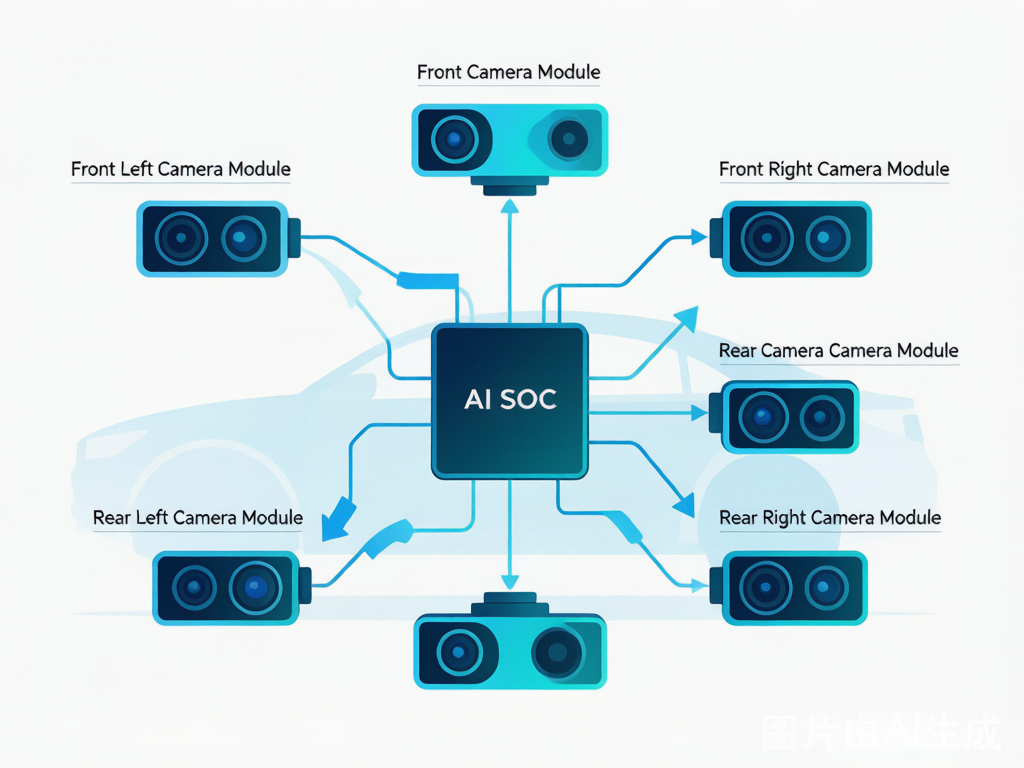
The Pitfall: Chips like the iND881 support multi-channel video input simultaneously. A single vehicle may carry 6 to 8 cameras. Many procurement teams still apply consumer electronics logic, inspecting each module individually — if a single unit meets spec, it passes. But automotive applications demand "intra-group consistency": the white balance, color reproduction, and exposure response of all 6 cameras must be highly uniform, or the stitched surround-view image will show visible color and brightness discontinuities.
The Solution: At the selection stage, specify "intra-batch consistency" metrics to your module supplier. Key parameters include: batch deviation of the sensor's raw response curve, residual error after lens distortion correction, and optical center offset after module assembly. A reliable module manufacturer will provide ATE (Automated Test Equipment) binning data for each batch, sorting modules by response characteristics and ensuring all cameras on the same vehicle come from the same bin. If this isn't agreed upon before mass production, software-based calibration will cost several times the engineering effort downstream.
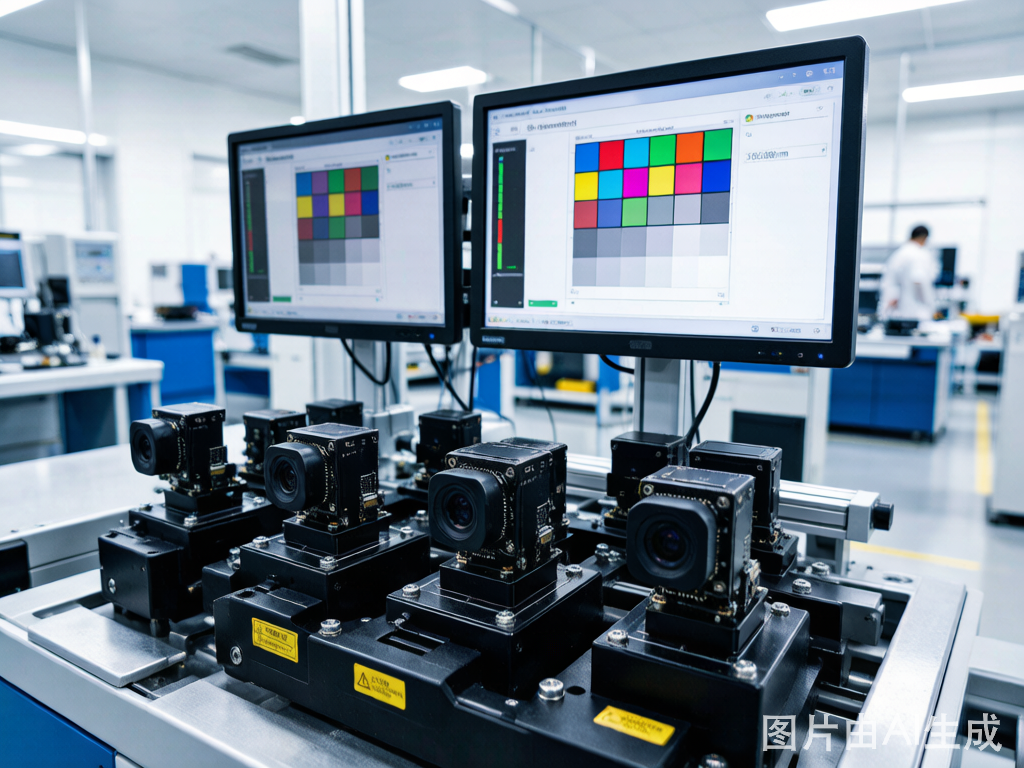
The Pitfall: The iND881's HDR ISP boasts sub-1ms latency — impressive, but only if the raw data from the module is clean enough. Many buyers focus exclusively on the dynamic range specs in the chip datasheet, overlooking the fact that lens stray light, sensor dark current, and FPN (Fixed Pattern Noise) at the module level also eat into dynamic range. No matter how powerful the chip's compute is, garbage in means garbage out.
The Solution: When evaluating modules, scrutinize three module-level metrics: first, the lens anti-stray-light coefficient, which directly determines ghosting in backlit scenes; second, the sensor's dark current characteristics, which affect signal-to-noise ratio at elevated temperatures; third, the module-level FPN correction capability — good module manufacturers perform per-unit dark-field calibration before shipment to suppress FPN to acceptable levels. We recommend requesting real sample images captured at high temperature (85°C and above) during the prototyping phase, rather than relying solely on room-temperature spec sheets.
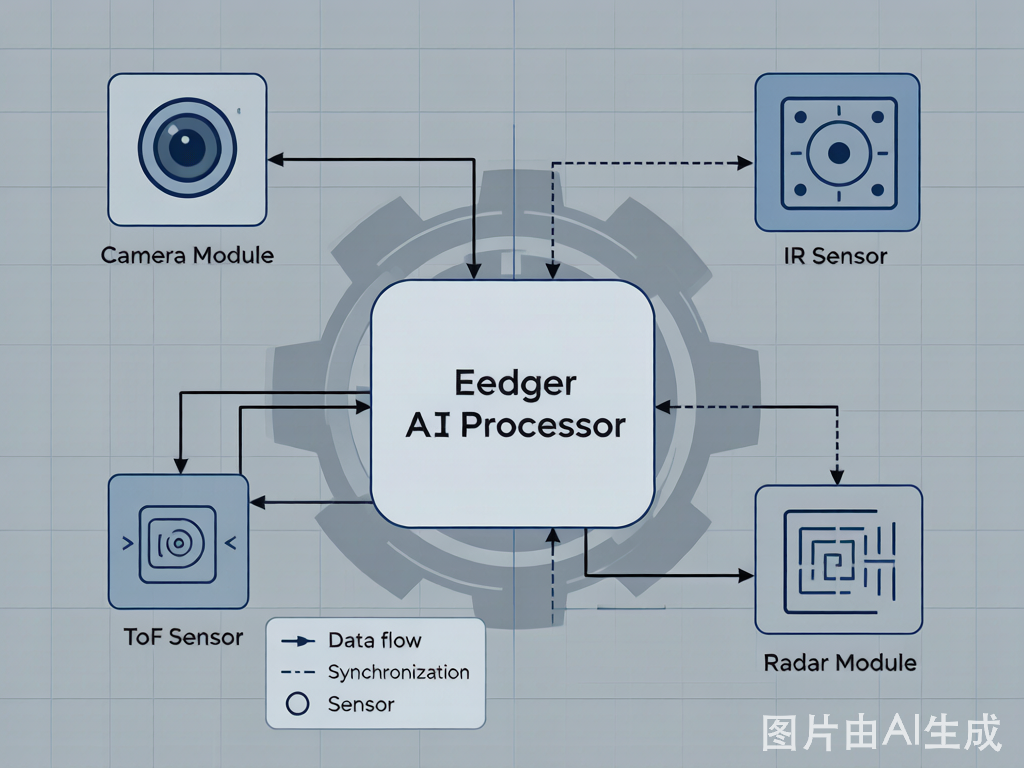
The Pitfall: The iND881 supports camera, infrared, thermal, ToF, radar, and LiDAR inputs. This means the camera module is no longer an isolated component but one node in a larger perception system. Many module manufacturers only know how to build cameras, not how to physically align and synchronize them with ToF or IR modules, leading to parallax errors and time-sync issues during integration.
The Solution: When selecting a module partner, evaluate whether they have "multi-modal module" design experience. Key criteria: Can they provide a combined camera + ToF module solution with guaranteed physical coaxiality? Do they have hardware-level sync trigger capability to ensure exposure timestamps are aligned across modules? How strong is their FPC/FFC design capability — multi-sensor fusion means more complex routing, and signal integrity is a common pitfall in mass production. A module partner with proven cases in these areas can save enormous integration and debugging time.
The Pitfall: indie's acquisition of ams OSRAM's CMOS sensor business signals chipmakers extending downstream. Some buyers worry: if chipmakers control both the chip and the sensor, will module manufacturers be marginalized? The concern is understandable but overstated — chipmakers build sensors to optimize chip-sensor co-design, not to replace module manufacturing. The core value of a module maker lies in optical assembly, test calibration, and mass-production consistency control — capital-intensive processes that chipmakers neither want to nor excel at managing.
The Solution: Procurement teams should reframe module manufacturers as "system-level integration partners" rather than simple assembly subcontractors. Specifically: First, involve the module partner early in chip selection discussions so they deeply understand the chip's ISP characteristics and can optimize the module's optical and sensor configuration accordingly. Second, require the module partner to demonstrate the ability to fine-tune module-level parameters based on the chip's ISP — for example, optimizing the sensor's color filter array parameters for a specific ISP's demosaic algorithm. Third, verify that the module partner's test system covers "chip-module co-debug" validation, not just standalone module testing.
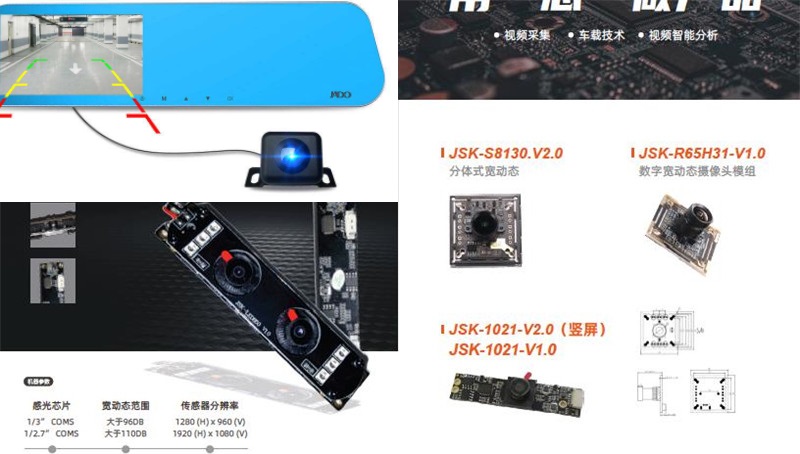
The pace of edge AI chip evolution far outstrips the iteration speed of the module side — and this gap is the single largest risk point for buyers and engineers. indie's strategic moves are just one snapshot of an industry-wide shift toward "chips define perception, modules deliver performance." Jinshikang Technology has deep expertise in camera module manufacturing, covering consumer electronics, automotive, security, and industrial inspection applications, with full-chain capabilities from selection consulting to mass production control — helping overseas OEM/ODM customers navigate the chip-module co-design era with confidence.


AR0230---1/2.7 HD 2M Wide Dynamic
Fatigue Monitoring Camera Module
Motion DV Camera-720P-120 Degree Wide Angle Camera Module
Night Vision Monitoring Camera Module
Monitoring - Doorbell - Law Enforcement Instrument Camera Module
Ten Thousand Trillion Industrial Camera Camera Module
 13423810014
 0755-29433686
 daming@cameras-module.com
 2/F, Building H, Zhiyihan Industrial Park, Yuanling Village, Shiyan Town, Baoan District, Shenzhen 518108



We use cookies to enhance your browsing experience. Continuing to browse indicates that you agree to our cookie policy.