In July 2026, a leading Chinese optics player announced the spin-off of its machine vision business into an independent company, aligning with several embodied-AI customers across humanoid robotics, quadruped robots, and autonomous vacuum cleaners, while continuing to serve major floor-care brands as a core supplier. The news may look like a routine corporate reorganization, but it actually signals a much bigger industry shift: Embodied AI is moving from laboratory demos to real mass production, and demand for robot-vision camera modules is entering a genuine boom phase.
For procurement teams and hardware engineers, the harder question behind this shift is that the selection logic that worked for consumer electronics and automotive vision almost never survives a direct transplant into robotics. A camera that "takes clear pictures" is not the same as a camera a robot can actually use. This article walks through five of the most common hidden traps in robot camera module selection, hoping to help OEM/ODM teams who are currently evaluating robot vision options.
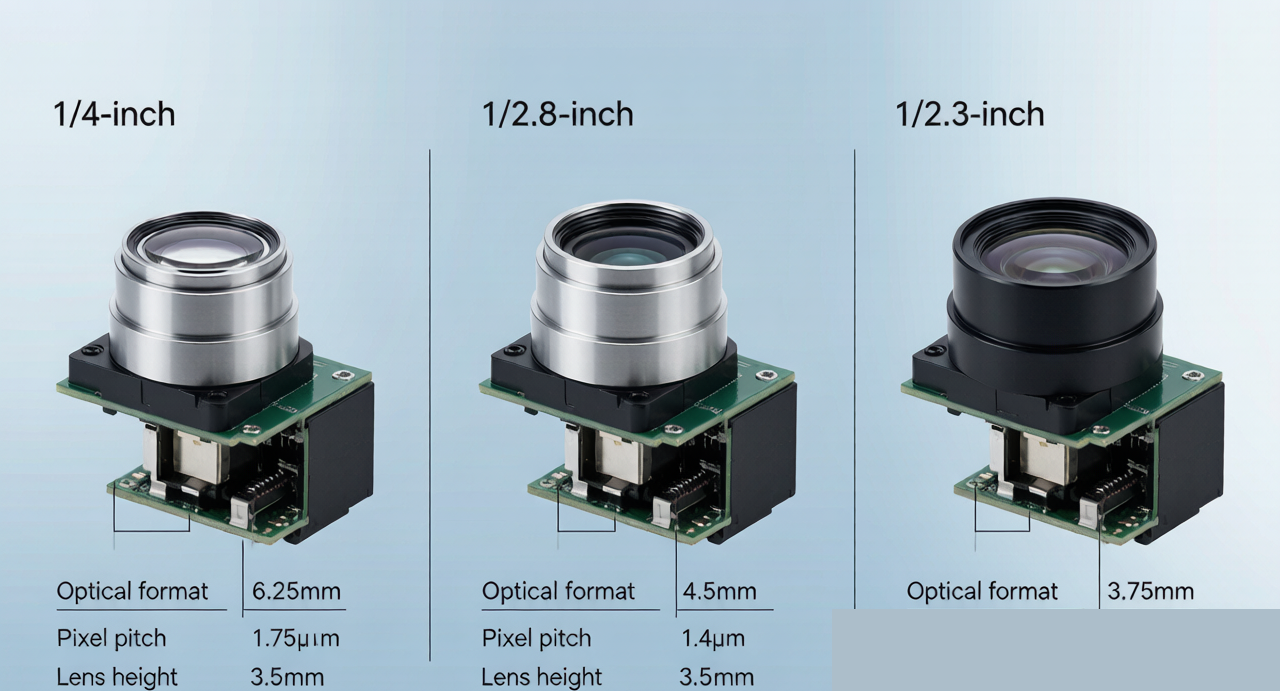
Why it is a trap: The first instinct of many teams is to take a smartphone camera reference design, shrink the footprint, and lower the resolution. But once the optical format drops from 1/2.3-inch to 1/4-inch or smaller, the loss in light gathering, signal-to-noise ratio, and lens resolving power becomes non-linear. A 1.4μm pixel in low light is simply not the same as a 2μm pixel.
Where the trap lies: Robot chassis space is extremely tight. The top bump on a robot vacuum may be only 20mm tall, an AGV's vision mount may be only 15mm wide, and a camera on the end-effector of a robotic arm may have only a few cubic centimeters of space, while still leaving room for cables, connectors, and thermal management. Forcing a large-format module into such a chassis either compromises mechanical structure or compromises optical performance.
How to break it: When selecting, work with the module vendor to jointly define the optical, mechanical, and electrical boundaries. Let the supplier derive a reasonable sensor format, lens height, and field of view based on the final system constraints, rather than copy-pasting a consumer reference design and asking the mechanical engineer to "figure out how to fit it in." For entry-level robots under a certain cost target, a 1/4-inch sensor with 1.4μm pixels and a short-focal-length lens is a reasonable cost-performance compromise. For higher-end scenarios, evaluate 1/2.8-inch or larger sensors with custom low-distortion lenses directly.
Why it is a trap: Mobile robots are far more power-sensitive than either consumer electronics or automotive applications. A home robot vacuum needs to run 2-3 hours per charge. If each camera module consumes an extra 200mA, battery life drops by 8-10%. But blindly chasing the lowest possible power budget sacrifices image quality and ultimately undermines SLAM, obstacle avoidance, and object recognition stability.
Where the trap lies: Many "low power" module designs simply reduce the host clock and cap resolution at 720P, but in doing so, they also strip out ISP capability, encoding efficiency, and HDR synthesis performance. These "low-power-for-the-sake-of-it" designs perform poorly in real scenes: motion smear in backlit conditions, cliff-edge recognition drop at night, blurry edges on moving objects.
How to break it: Evaluate power using an "equivalent perception capability per milliamp" metric rather than looking at mA alone. On the same 200mA budget, a design that integrates a hardware ISP, hardware 3A, and H.265 encoding delivers far more effective pixels per milliamp than a soft-compressed alternative. When talking to module vendors, ask the explicit question: "At 1080P@30fps with hardware 3A and HDR synthesis enabled, what is the total board power?" Not the lowest number in the datasheet, but the real workload figure.
Why it is a trap: Robots are "always in motion." A robot vacuum has to handle the bumps of carpet transitions. An AGV has to deal with micro-vibrations of an industrial floor. A humanoid robot has to cope with the periodic sway of bipedal walking. All of these motions show up on the CMOS sensor as "jello effect" — vertical lines stretched into parallelograms, motion contours distorted and smeared.
Where the trap lies: The rolling shutter that works perfectly in static consumer scenes becomes a disaster on a robot. A single frame's exposure window may span 30ms, during which the robot itself has moved several centimeters. The recognition algorithm then operates on a "distorted reality." Global shutter solves the jello problem, but at higher cost, weaker low-light performance, and relatively lower signal-to-noise ratio, so it is not always the right answer.
How to break it: Differentiate by use case. SLAM, visual odometry, and AGV localization algorithms that are sensitive to geometric accuracy should prefer global shutter. Target recognition, face detection, and object classification algorithms that are not sensitive to single-frame distortion can work with rolling shutter plus hardware image stabilization. Also pay attention to multi-camera time synchronization: in a multi-camera robot system, if the two sensors' exposure moments differ by 5ms, the fusion algorithm will perceive one object as two. A serious module vendor should be able to provide a hardware trigger signal or a multi-sensor synchronization scheme.

Why it is a trap: Robots need "distance perception" just like humans, but they obtain it in very different ways. ToF looks like the easiest path — plug it in and you get a depth map — but outdoor strong sunlight, specular reflections, transparent objects, and long-distance targets can all cause ToF fail completely.
Where the trap lies: Many module vendors pitch ToF as a "differentiating feature," but robot scenarios are extremely varied. A home robot vacuum works primarily indoors at close range, where ToF is fine. But a service robot has to enter elevators, operate in strong light, and stop in front of glass doors — all scenarios where ToF performs poorly. Stereo vision handles strong light better, but it requires heavy compute and depends on texture. Structured light gives high precision but suffers rapid range attenuation.
How to break it: Do not be misled by "one ToF to rule them all" marketing. A serious module vendor should be able to recommend a combination based on the customer's typical working distance, typical lighting, and typical target types. A common combination: ToF or structured light for indoor short range (accuracy priority); stereo plus AI monocular depth for outdoor medium-long range (robustness priority); global shutter with active IR illumination for strong-light scenarios.
Why it is a trap: Many engineers assume that "automotive-grade camera modules are good enough for robots." But a robot's working environment is more complex than a car's. A car at least operates inside an enclosed cabin. A robot faces an open industrial site or a chaotic home environment.
Where the trap lies: Industrial robots must deal with dust, oil mist, and metalworking fluid. They face temperature swings from -20℃ to 70℃. They must withstand random vibration from 5 to 500Hz. Home robots must survive impacts from children, chewing from pets, and humidity from bathrooms. Outdoor robots must endure heavy rain, scorching sun, and windblown sand. None of these is a primary design scenario for an automotive-grade camera.
How to break it: Ruggedness is not solved by "making the housing thicker." It must be addressed across four dimensions simultaneously: sensor selection, lens coating, sealing process, and structural materials. Module vendors need to provide a clear "operating-condition matching table" — what sealing grade for dusty environments (IP5X or IP6X), what temperature compensation algorithm for wide-temperature operation, what connector retention method for high-vibration environments. There is no such thing as a "universal module." Customization by scenario is the right way.
"Opening the eyes" of embodied AI is not as simple as installing a camera that takes clear pictures. From compact form factor to power co-design, from shutter synchronization to depth architecture, from environmental ruggedness to cost control, every item requires deep involvement from the module vendor during the early definition phase. The wrong approach is to wait until the mechanical design is finished, then go find "a camera that is close enough" and try to fit it in.
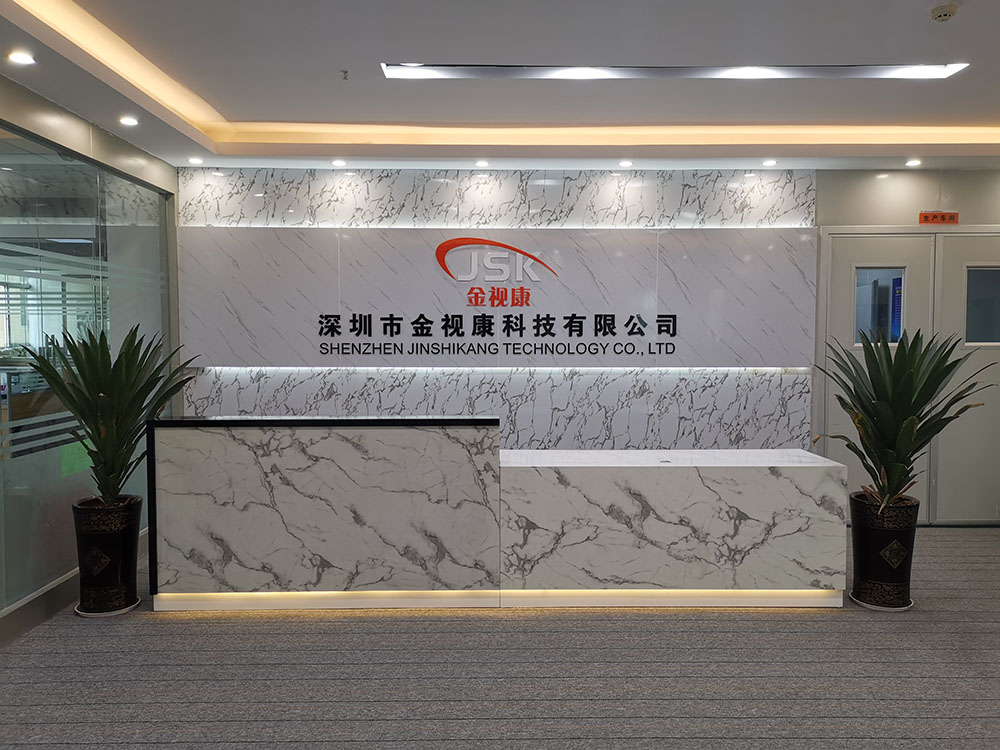
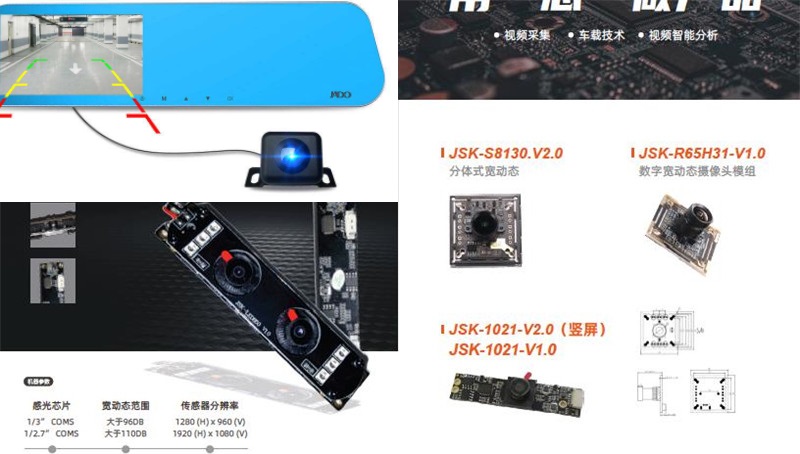
With years of experience across consumer electronics, automotive, smart home, and industrial inspection, and an established track record in robot vacuums, AGVs, and service robot vision programs, our team at Jinshikang Technology can support customers end-to-end — from optical selection and structural adaptation through to stable mass production supply.


AR0230---1/2.7 HD 2M Wide Dynamic
Fatigue Monitoring Camera Module
Motion DV Camera-720P-120 Degree Wide Angle Camera Module
Night Vision Monitoring Camera Module
Monitoring - Doorbell - Law Enforcement Instrument Camera Module
Ten Thousand Trillion Industrial Camera Camera Module
 13423810014
 0755-29433686
 daming@cameras-module.com
 2/F, Building H, Zhiyihan Industrial Park, Yuanling Village, Shiyan Town, Baoan District, Shenzhen 518108



We use cookies to enhance your browsing experience. Continuing to browse indicates that you agree to our cookie policy.