In July 2026, Vietnamese EV manufacturer VinFast and Israeli AI company Autobrains announced that their "Robo-Car" autonomous driving architecture had entered controlled-zone testing in Hanoi. The system uses seven production-grade cameras and a compact computing platform delivering approximately 20 TOPS, completely eliminating LiDAR, radar arrays, and HD maps. It relies on Autobrains' Agentic AI architecture and Air-to-Road visual localization to perceive the environment. This mirrors the "vision-only" philosophy championed by Tesla and Xpeng: replacing expensive, complex sensor-fusion suites with more and better cameras.
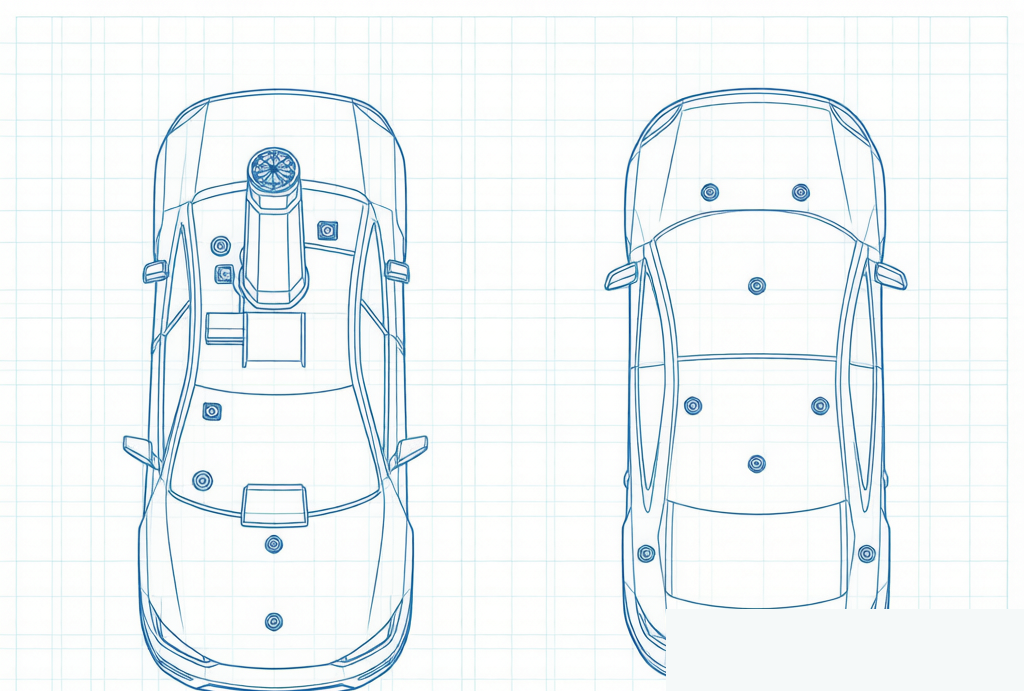
For camera module procurement professionals and hardware engineers, the signal is unmistakable: cameras are evolving from "supplementary sensors" to "the sole perception source." When LiDAR and radar are removed, a camera module's reliability, performance consistency, and production yield will directly determine the ceiling of vehicle safety. This is both an opportunity — more cameras per vehicle with higher specification requirements — and a challenge, as the margin for selection errors narrows dramatically.
Why it's a trap: In traditional multi-sensor fusion architectures, LiDAR, radar, and cameras serve as mutual redundancies. If one camera module degrades under extreme conditions, other sensors compensate. Camera-first architecture removes this safety net, meaning a single module's failure or performance decay can create a direct perception blind spot.
Where the trap is: Many procurement teams still apply "multi-sensor era" reliability standards, focusing on room-temperature yield and basic functional testing, without deeply validating scenarios like extreme thermal cycling (-40C to +85C), optical alignment drift after prolonged vibration, or adhesive aging in high-humidity environments. Camera-first architecture demands that modules maintain optical performance stability throughout their entire lifecycle, placing higher demands on AA (Active Alignment) precision, adhesive selection, and stress management.
How to break through: During supplier evaluation, "single-point failure consequences" must be incorporated into the risk matrix. Require suppliers to provide MTF (Modulation Transfer Function) degradation data after at least 1,000 hours of 85C/85%RH damp-heat aging, and optical axis offset measurements after simulated 10-year vibration profiles. Procurement specifications should explicitly define "optical performance degradation thresholds," not just initial yield rates.
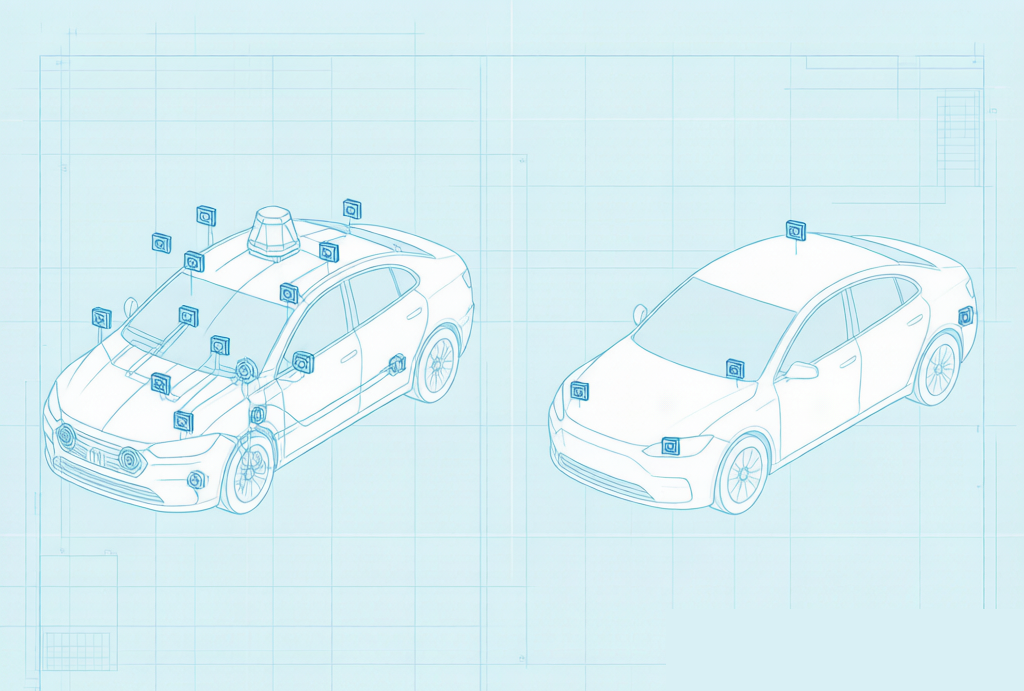
Why it's a trap: VinFast's Robo-Car employs seven cameras covering front telephoto, front wide-angle, side, rear, and surround-view positions. Each camera requires a different field of view, resolution, and dynamic range. This is not "buy seven identical modules" — it is a specification matrix.
Where the trap is: A common mistake in practice is the "one-size-fits-all" approach — using the same specification for all positions to simplify supply chain management. The result is either insufficient long-range recognition when wide-angle modules are used in telephoto positions, or wasted compute and cost when high-resolution modules are deployed for surround-view. Another pitfall is underestimating the environmental protection requirements that differ by position: front-facing modules face stone chips and high temperatures, side modules face washing and mud, and rear modules face exhaust contamination.
How to break through: Establish a "camera position-specification matrix" at project kickoff, defining five core metrics for each position: field of view, resolution, dynamic range, protection rating, and operating temperature range. During supplier negotiations, prioritize module manufacturers that can cover multiple specification requirements, reducing the supplier count while increasing category depth per supplier. This not only reduces BOM complexity but also enables better delivery coordination and quality traceability during mass production.
Why it's a trap: The reason camera-first architecture can "dare" to eliminate LiDAR is the premise that camera dynamic range and low-light performance are sufficient. But LiDAR relies on active laser pulse emission, immune to ambient lighting; cameras are passive imaging devices whose performance at tunnel entrances, in night rain and fog, or facing oncoming headlights directly determines the system's safety boundary.
Where the trap is: The dynamic range figures on module spec sheets typically represent peak values under ideal laboratory conditions. In real road scenarios, factors such as lens flare, sensor blooming, and ISP processing latency can reduce effective dynamic range well below nominal values. If procurement relies solely on spec sheet numbers without real-vehicle scenario validation, post-production issues may include dark-detail loss or highlight overexposure causing target misdetection.
How to break through: During module selection, require suppliers to provide "scenario-level dynamic range test reports" — not laboratory integrating sphere data, but imaging samples simulating real conditions like tunnel entrances (1:10,000 contrast ratio) and nighttime oncoming traffic (point-source interference). Additionally, pay attention to inter-frame latency in HDR modes — if multi-frame fusion delay exceeds 33ms, target position estimation errors may occur at high speeds. For module manufacturers like Jinshikang Technology with full optical design through AA assembly capabilities, lens coating schemes and ISP tuning parameters can be customized at the module level to optimize dynamic range performance for specific applications.
Why it's a trap: VinFast's core motivation for choosing camera-first architecture is cost reduction — replacing LiDAR and radar arrays with seven cameras can save tens of thousands of dollars per vehicle in hardware costs. But this "total cost reduction" often means a double squeeze for module suppliers: "lower unit prices, higher volumes."
Where the trap is: When automakers calculate cost savings, they redistribute the LiDAR budget across camera modules — not by increasing your price, but by demanding lower prices under more stringent specifications. Some module makers, to win orders, compress profit margins during quoting, only to find yield ramp difficulties and high rework costs during production, ultimately falling into a downward spiral of "the more they produce, the more they lose."
How to break through: Full-cost accounting must be performed during the quoting stage — not just BOM and assembly labor, but also scrap costs during yield ramp, engineering change costs, and after-sales warranty costs. In customer negotiations, a "tiered pricing" strategy can be adopted: slightly higher prices during yield ramp, with price reductions upon reaching target yield. This protects your margins while giving customers a clear cost-down trajectory. More importantly, module manufacturers with flexible production line capabilities can reduce multi-variant switching costs through rapid line changeovers, gaining leverage in price negotiations.
Why it's a trap: VinFast chose Hanoi for Robo-Car testing partly because of its extremely complex traffic environment — dense motorcycles, faded lane markings, and intersection navigation by "negotiation." If a camera-first system can work here, it can theoretically adapt to most cities worldwide. But this testing logic implies a prerequisite: every mass-produced module must perform with high consistency relative to the modules on the test prototype vehicle.
Where the trap is: During engineering sample production, modules are hand-assembled and individually calibrated by senior technicians, yielding very high performance consistency. But in mass production, cycle times compress from 30 minutes per unit to 15 seconds, and AA equipment repeatability, dispense volume variation, and curing temperature uniformity all introduce consistency deviations. If systematic optical performance differences exist between mass-produced modules and engineering samples, the safety boundaries validated on prototype vehicles are no longer valid.
How to break through: During production planning, require module suppliers to provide an "engineering sample vs. mass production performance benchmarking report," quantifying statistical parameters (Cpk values) for AA calibration precision distribution, MTF consistency distribution, and color consistency distribution. Specifications with Cpk below 1.33 must be placed on the critical control list. Additionally, implement a "first-article vs. last-article comparison" system during yield ramp to ensure batch-level performance drift remains within control limits. Jinshikang Technology has accumulated extensive production consistency management experience on multi-variant flexible production lines, providing end-to-end quality assurance from engineering samples to mass production ramp for camera-first architecture customers.
VinFast's Robo-Car is a microcosm of a broader trend — from Tesla to Xpeng, from North America to Southeast Asia, camera-first architecture is reshaping the autonomous driving sensor supply chain. When cameras become the sole perception source, module reliability, specification differentiation, dynamic range, cost control, and production consistency are no longer "bonus features" but "entry barriers." For OEM and ODM customers evaluating camera module suppliers, Jinshikang Technology specializes in camera module manufacturing, covering OEM/ODM orders from consumer electronics to automotive applications, with full-chain capabilities from optical design through AA assembly to production management. We welcome the opportunity to connect and collaborate.


AR0230---1/2.7 HD 2M Wide Dynamic
Fatigue Monitoring Camera Module
Motion DV Camera-720P-120 Degree Wide Angle Camera Module
Night Vision Monitoring Camera Module
Monitoring - Doorbell - Law Enforcement Instrument Camera Module
Ten Thousand Trillion Industrial Camera Camera Module
 13423810014
 0755-29433686
 daming@cameras-module.com
 2/F, Building H, Zhiyihan Industrial Park, Yuanling Village, Shiyan Town, Baoan District, Shenzhen 518108



We use cookies to enhance your browsing experience. Continuing to browse indicates that you agree to our cookie policy.